Showing posts with label Chain-Link Coverage. Show all posts

Wednesday, May 23, 2012

Beautify a Chain-Link Fence: Paint It Black, Or Partly Dismantle It

Here are two thoughts on how to alter the appearance of a basic chain-link fence. For once, this is not about growing plants on or around it. It's about the fence itself.

1. I came across this very unique approach in Hyde Park the other day.

A partly dismantled chain-link fence
Chain-link fences are a fact of life for many of us. Digging out the posts can be quite strenuous. The posts are sunk into concrete that has been poured very deep into the ground. Digging them up can cause plants or structures around it to collapse into any remaining holes. You could rent a metal-cutting power saw and just saw them off at the base...but you still wouldn't be able to plant anything where the concrete is.


This gardener shows how you can remove just the chain-link part of the fence. This works especially if you don't need a secure yard for a dog etc.. Then it might look like this (above and below):

These large sculptures take the place of the old chain-link mesh

I am really quite fond of the contrast (below) between the beautiful traditional garden on the right, with its trim white picket fence and tidy potted flowers, and the striking bohemian garden on the left. Both are eye-catching, and even more so for being right next to each other.

Add caption
So what else could you do with a chain-link fence to make it look a little less like... a chain-link fence?

2. You could paint it black (or green etc.). Purchasing an already black chain-link fence would be better. But I think black is within your reach if you want it. Just try to do it before your clinging vines are established. You could also use Rustoleum's Chain-Link Fence Paint to brighten a rusted silver fence back to its original, gleaming industrial shine. Your choice!


I would paint my own fence black now, but my clematis and a few other plants prevent me from doing so. I also think that if you really want it to look neat and clean in black, the fence needs to be pretty straight. If it is leaning here and there, that's where you should grow some plants!



Wednesday, April 11, 2012

A Short Chain-Link Fence

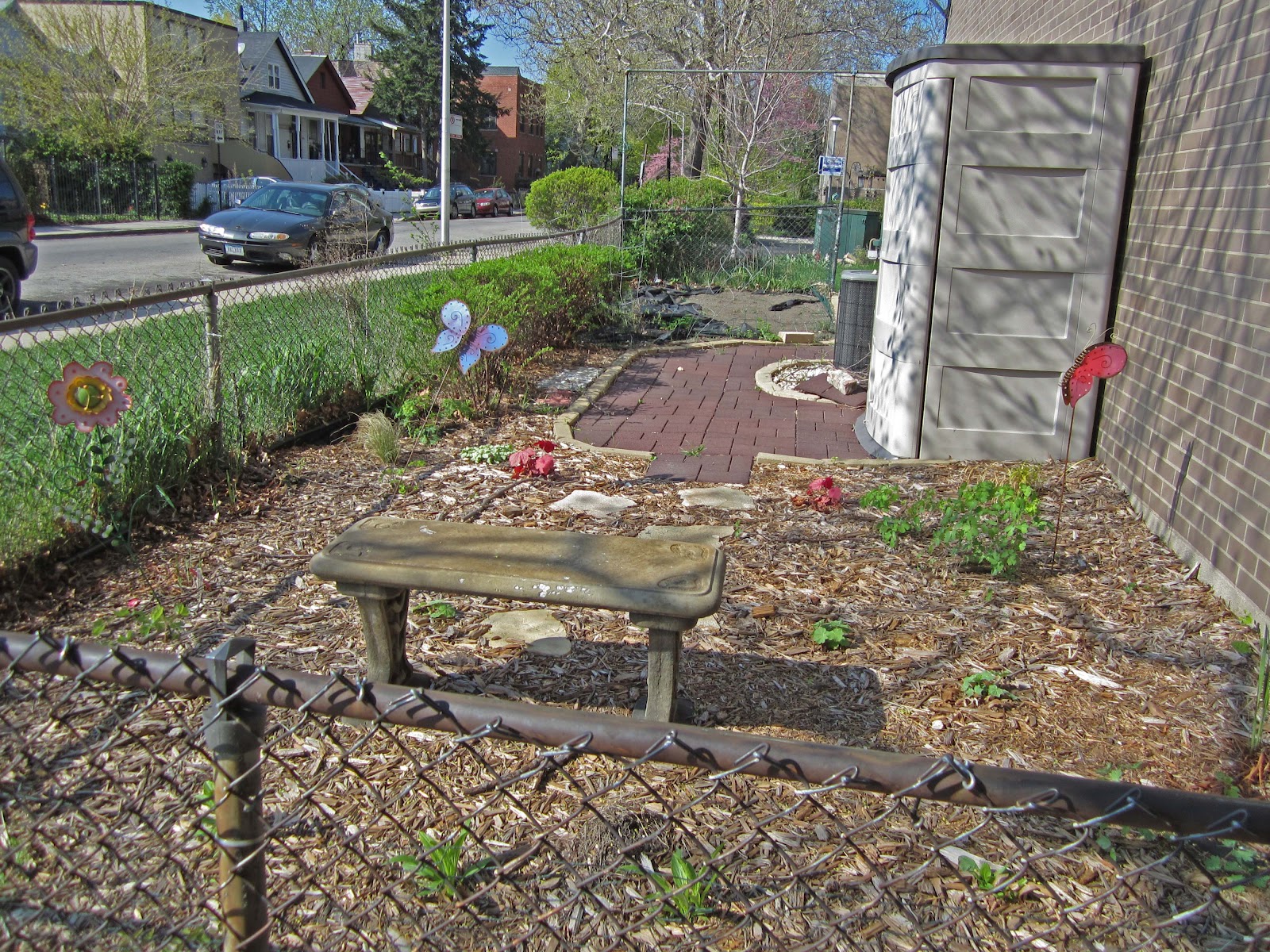
For about a year now I've had my eye on this newly revamped garden. The chain-link fence is even shorter than mine--3 feet tall at most.  It actually looks taller in this photo:


I can't remember what used to be here--I guess not much. But I remember the day I walked by and saw that little stone bench, which is probably less than two feet high itself. This makes perfect sense. You can imagine how a regular sized garden chair would pop up above the fence line, the proportions all out of whack. But with this very small, complementary stone bench, I imagine a different scene instead--maybe a child sitting there in the sun while a parent tends the tomatoes. In other words, the fence is the last thing I notice, and its height seems "about right" rather than "short."

While the new plants are growing in, the garden decor offers colorful whimsy.


One can imagine a banana scented butterfly bush in here, with real butterflies floating about.


It's amazing how that bench, some new mulch, a patio, and a few stepping stones turned the formerly nondescript urban space into a very cute, tidy garden. 

Some musings on what to do with a shorter chain-link fence:

Clearly, aim to find a focal point that is the right size!

If privacy is not an issue, and the height of the fence will not be changed, I might try extending the miniature garden theme to go with the little bench. Miniature roses, crocuses, Siberian squill, sweet woodruff...a tiny pond, or painted bird houses. Maybe a Japanese Maple somewhere, pruned accordingly.

A miniature children's garden would also be interesting. I picture vintage toys, like an old red wagon planted with ranunculus or any extremely bright flowers.

On the other hand, if privacy is wanted soon-ish and on the cheap, a shrubby border would do. Lilac or forsythia might even engulf the fence, hiding it entirely. If you use grapevine or ivy, you could eventually add in a taller trellis to increase the height. 

Really, the possibilities abound. I look forward to seeing what the gardener here decides to do. Even if he or she puts in a big wooden fence, at least I'd know it was nice inside!


Wednesday, February 15, 2012

Dressing Up Your Chain-Link Fence

This caught my eye last summer when I was in Sweden. I was very impressed.

A cleverly disguised chain-link fence
Depending on the length of the chain-link fence, it might not be very expensive to buy the tiles. These look like plastic to me, and they're not half bad. The silvery white lamp is a nice touch at the end. The industrial gray post is complemented by the natural gray of the stones. The stones also suggest a pleasing solidity. That's something that bothers me about chain-link fences: although I know they're very strong, they tend to rattle in the wind and look flimsy. But these stones, along with the tiles, give the fence some weight while conveying a sense of cozy enclosure.

One very good question is how those tiles are stuck on. If I were to attempt this--and I'm considering it--I might start with simple kitchen and bath caulk. I think I could scrape it off if necessary. Maybe sticky-backed Velcro would work. For some reason I balk at the idea of making it more permanent. What if a tile breaks and I can't find a replacement? I also think smaller tiles might stay on more securely.

In any case, I'm charmed. I will be keeping an eye out for these tiles!

Tuesday, December 20, 2011

Winterized Chain-Link Fence and Garden Cookies

I am in the middle of my annual winter garden sulk, so I made "holiday" cookies yesterday as I saw fit:


Chain-link garden cookies

What looks better, the cookies or my winterized chain-link garden? Either way, one will be gone tomorrow--I know that much. I've been tossing around ideas as to what could make a chain-link garden look festive in the winter, and finally wound up wrapping this fake garland around the fence top, arbor and shepherd's hooks...all to uncertain effect:


At the very least, the garland catches the snow nicely, and the birds seem to alight on it happily.

Garlanded shepherd's hooks, with baskets left up as bird-feeding platforms

A garlanded section of chain-link fence, dusted with snow
I thought about entwining the fence with even more of the garland, but never found time to do it. It looks a bit worse if you hastily drape it everywhere, and weaving it in and out of all the links proved somewhat maddening. I found later, though, that cutting the garland into shorter strips makes it a lot easier!

Friday, August 5, 2011

Chain-link Coverage: Grapevine (video!)

I return today to my interest in plants that go well with chain-link fences. What about grapevine (Boston Ivy, which is, confusingly, not ivy)? The particular variety I'm referring to is (I think) parthenocissus tricuspidata, and it's all over Hyde Park and covers many University of Chicago buildings. The grapes aren't fit for humans to eat, but birds love them in the fall.

Here is a photo of the vine growing on and sticking to a brick wall. It does not necessarily twine about things on its own (more on this problem below).

Grapevine has one magical quality that I must share, and it requires video. When the grapes begin to ripen (the video was taken in late July 2011), the outer casing bursts open and pops off. There are so many dozens of grapes per cluster, and so many clusters per vine, that the effect is like some sort of dry rain. Have a look:
It leaves a bit of green "confetti" on the ground afterward, which later turns brown (and tracks into your house!). However, it disintegrates fairly quickly on its own, or you can brush or spray it aside.


But how does it work on a chain-link fence? The photo below suggests that grapevine can provide good coverage, but also that training it properly may require some care. Here, left untended, it is growing straight up and then flopping over on itself, rather than moving sideways across the the fence. I can imagine going out every few days to weave it in and out of the wire mesh myself.


So...some PROS for grapevine on a chain-link fence:
*it leafs out early, and hangs on fairly well in the fall (turning beautiful colors)
*coverage can be dense
*grows quickly
*you can get a clipping easily in Hyde Park and start your own vine using rooting hormone (I'm told)
*grapevine "rain" offers a zen-like experience
*it will come back every year; the main vines become thick and woody and will eventually provide winter interest even without the leaves
*may attract birds, or even huge flocks (starlings especially, as far as I've seen), which is fun for humans and cats too!

Some CONS:
*It can be quite invasive
*You have to clean up the leaves in the fall...they leave a thick matting on the ground
*You'll have to train it at least a little on a chain-link fence or trellis
*You'll need to think about what to do if it spreads to a nearby building (or your own building!)... it is easy to pull off, but if it's very high up, it could present problems

I like mine, and I wish I had grown it over my chain-link fence years ago. Other peoples' experiences with it are welcome!

Friday, June 17, 2011

Chain-Link Coverage: Climbing Hydrangeas

I haven't seen climbing hydrangeas on chain-link (yet), but they were recommended to me by someone at Gethsemane. I find the idea compelling...

For one thing, they provide winter interest. Just now, you'll have to use your imagination, but this close-up shows how the cinnamon colored branches might catch the eye when bare. Also, the thicker vines tend to exfoliate in fascinating ways. When mature, the branches may even provide a little woody coverage all by themselves.

They are not self-clinging; you have to train them when the new growth is soft and flexible. I was assured this would work on a chain-link fence in any case.


I don't have any experience with hydrangeas, but the worst problem I can think of is that they are very slow to start. It could take years to get good coverage.

Photo taken around June 1st
But once you do, they might look like this. Notice there are some gaps in the coverage--even growth may be hard to achieve. But I like the gaps. They're mysterious, something to peek through.

Each small plant costs $15-$50, which could be another problem if you have a huge fence. But think...my (very cheap) morning glory is still at most 1 foot high, and it's June 17th. This climbing hydrangea has been lush and full for weeks. 


Because of its slow growth, this is not a plant for those in a temporary space. But if your more permanent gardening area features chain-link, and you don't mind fussing a bit, you'll probably be pleased with this in no time. For gardeners, time flies anyway (no matter how impatient we are). I also think those big heart shaped leaves would contrast superbly with the small square pattern of chain-link.

Friday, June 10, 2011

Chain-Link Coverage: Nasturtiums

This isn't technically a chain-link fence, but the idea is the same. It's a wire mesh structure that I wanted to cover up. I can't live without nasturtiums in my garden, but for various reasons, they are not my first choice for covering my actual chain-link fence. They might, however, be yours...


Here are the pros and cons.

Pros:
*they're easy and cheap to start from seed indoors; they are even easier if they're allowed to re-seed themselves outdoors in the ground (and then the plants seem healthier anyway).
*they attract hummingbirds like crazy!
*you can eat them, or so I hear; please read your seed packets carefully before you eat anything! They have a strong peppery smell that would either define an appetizer, or possibly overwhelm a salad.
*they offer lush, bright green foliage that contrast well with a chain-link fence--lovely, round large leaves that would soften any metal structure
*they do pretty well in hot, dry conditions
*they last a VERY long time at the end of the season, even with light frost; they are among the last plants to die in my garden each fall
*if you keep dead-heading the flowers, they keep blooming
*easy to remove when they die in the fall; unlike morning glory, the vines are easy to break and yank loose from mesh structures

Cons (or reasons they are not absolutely perfect):
*not self-clinging; you have to tend them every few days, weaving them in and out of your fence
*they start from seed each year, which means they won't grow up to waist height until early to mid-July each year; but they can get to be 6 feet tall by late August
*some people have trouble starting them indoors; I started some easily in March indoors, but had trouble in May. Don't know why. They start themselves outdoors very well, especially if they choose their own spot on their own terms (I had less success just throwing seeds in the ground myself in the spring)

And that's about it. I love them, but I tend to want coverage earlier, and my fence is long enough that continually weaving them in and out of the mesh is a nuisance. If you fail to tend them, they can flop forward, and possibly break. They also don't like to be transplanted once they have started outdoors somewhere. I've tried moving "volunteers" to where I want them, and I find that while they survive, they struggle at first.

But they are quite nice, and they also come in pretty dwarf varieties for pots.

Tuesday, May 31, 2011

Bad Plants for Chain-link Gardens?


Climbing plants aside, do some plants look better than others next to a chain-link fence? This isn't a great shot, but it's actually true to life.That's an astilbe there, in case you didn't see it. Not the lovely green columbine with pink flowers to the right, the irises and lilies-of-the valley in the back, nor the flopping tulip leaves to the left...but the shadowy thing in the middle.


I love astilbe. It likes part shade and comes back strong every year. It shoots up amazing red brushy plumes about twice each summer. The leaves are small, sharp and elegant, and it's easy to care for.

But sometimes I forget it's there. Some plants have to play a supporting role, fine. But it seems to me that those airy, thin, dark green leaves (with a dark reddish tinge) fail to pack a punch beside a chain-link fence. 


But look how these fat magnolia leaves offer such a great, soft, lush contrast to the fence, even hiding it. They give genuine substance to the garden, something a chain-link fence lacks, since it's practically all air (though that's a benefit, as I'll discuss in another post).


It's not just the height of the plant, I think. Take this humble chrysanthemum with its silvery green foliage. It's hardly bright, or translucent, and the leaves have a fine, feathered shape. Yet it stands out pretty well even from outside, perhaps because of its density.


Here is my azalea about a month ago. It's leaves are slightly bigger now, but not much. Against the see-through metal grid of the fence, the effect is frustratingly scattered. The leaves it has now, though slightly bigger, are a dark forest green, so the color just doesn't "pop".


Of course, azaleas also do this...which is why I keep it around.


Am I completely mistaken? Is it just my garden? Or is it possible to lay out guidelines for plants beside a chain-link fence? --Other than hiding it, I mean. Then again, I've also been reconsidering the supposed ugliness of chain-link fences. Perhaps I'm looking at it all wrong...

Sunday, May 22, 2011

Chain-Link Coverage: Clematis

Thanks to Hyde Park Cats for mentioning Chain-Link Trellis here along with a few other Hyde Park blogs! If you haven't heard about Hyde Park Cats, they have rescued more than 200 south side cats in just three years! But this is a non-cat blog. I can't compete with posts like this anyway!

So, back to plants.

It has been a long wait, but these seedlings are finally going out. I have seen it get frosty as late as June 5th, but if that happens, I'll just cover them up with pots or towels or something.

Most of this is my loot from the Hyde Park Garden Fair. About 20 individual plants there, and only half my entire seedling collection. If there are no new gardening posts this week, I'll blame it on...gardening. 

And now, the start of a collection of photos of "chain-link trellises" or how a chain-link fence can be covered up (or not) depending on your needs--the height of the fence or your desired level of privacy etc.

So I'll start with clematis. The pros are: it leafs out early every year, at maturity it's a good thick privacy screen, it's low maintenance, a high climber (8-10 feet), and there are many varieties with gorgeous blossoms (more pics later). I also like how I was able to train this one into a fan shape, so that air circulation in the garden is not compromised below, but there is still good coverage above. Last, clematis twines its tendrils around everything itself--you don't have to tie it up, which is a plus.                                                                                    
clematis; click 'Chain-Link Coverage' link at right of screen for
 more plants; clematis update coming soon

I also found these great pics of clematis on chain-link fences, along with info on specific varieties.

The cons are: a good clematis plant usually starts around $12-$20, which may put off some new, casual, or shoe-string gardeners. It's only a good investment....IF...

...you give it three years at least (as in the photo above, and that's just a 3 ft. fence). This here is my newer clematis. I planted it mid-summer last year. It is shooting up with great vigor, but is not providing any real coverage just yet. Another con can be "clematis wilt" (black leaves, stem rot). Two of my plants have had it and gotten over it; one brand new one died. It is frustrating, and quite common. At least be sure you don't buy a plant with black leaves already on it (I see that all the time). Or at least not more than 2-3 black leaves, and pick those off ASAP.
Three cheers for Treasure Island's latest array of outdoor plants! It's the best outdoor selection I've seen in Hyde Park in years. I haven't seen clematis there yet, but maybe one day...